
On this page
- Why Roswell lots make drainage harder
- Signs water is not draining away
- Ways to move water away
- Rain gardens and barrels in Roswell
- Who looks after the drainage system?
- A drainage plan in four steps
- Do's and don'ts
- Terms you will hear
- Drainage at a glance
- Where drainage matters around Roswell
- A first step worth taking
- Basements and crawl spaces
Why Roswell lots make drainage harder
Two things: clay and slope. Much of North Fulton sits on dense red clay that soaks up water slowly once it is wet. Many Roswell lots also slope, some steeply toward the creeks and the Chattahoochee, which forms the city's southern edge according to Wikipedia. Water dropped at the foundation on the uphill side of a house has nowhere to go; on the downhill side it can cut gullies through beds and across walks.
Signs water is not draining away
- Puddles along the foundation after rain.
- A damp or musty basement or crawl space.
- Soil washed out below downspouts.
- Red clay splashed onto lower siding.
- Gullies in beds or mulch washed onto walks.
Ways to move water away
| Method | How it works | Good for | Watch for |
|---|---|---|---|
| Extension | Pipe carries water out from the wall | Lots with some fall | Trip hazard; mower damage |
| Splash block | Spreads water at the outlet | Stopping erosion | Does not move water far |
| Buried line to a pop-up | Pipe under the lawn to an emitter | Getting past patios and beds | Needs fall; can clog |
| Buried line to daylight | Pipe out to open ground downslope | Hillside lots | Outlet must not erode |
| Rain barrel | Stores water for gardens | Summer watering | Overflow in storms |
| Rain garden | Planted dip that soaks water in | Gentle slopes away from the house | Placement and plants |
Rain gardens and barrels in Roswell
Roswell's watershed protection staff have shared guidance on rain gardens as a way to protect the city's streams and water supply, the AJC reported. A rain garden belongs well clear of the foundation, where the ground already slopes away. Rain barrels store a little water for dry spells; DeKalb County's rain barrel fact sheet explains how one connects to a cut downspout and notes that barrel water should not be used for drinking.
Who looks after the drainage system?
Roswell runs a stormwater utility for its public network of pipes, ditches and other structures that carry runoff to the nearest stream or lake, as the city's service document describes. During the September 2009 floods, the U.S. Geological Survey photographed an overflowing storm sewer on Riverside Road in Roswell that could not handle the volume of runoff. Letting some roof water soak in on your own lot, and keeping leaves out of what does leave, helps the system cope.
A drainage plan in four steps
- Map the water. After a heavy rain, mark where water stands and where each downspout empties.
- Find the low point. Note where water naturally goes: a swale, the street, a low corner or the slope below the house.
- Connect the two. Plan extensions or buried lines from each downspout toward that point.
- Protect the outlets. Add splash blocks or emitters so water spreads without eroding clay.
Do's and don'ts
- Do send each downspout to ground that falls away from the house.
- Do use splash blocks where water lands on soil.
- Do fit a cleanout on buried lines.
- Don't send water across walks or driveways where it leaves algae.
- Don't discharge onto a neighbor's lot.
- Don't tie into public drainage without checking the rules.
Terms you will hear
| Term | What it means on a Roswell house |
|---|---|
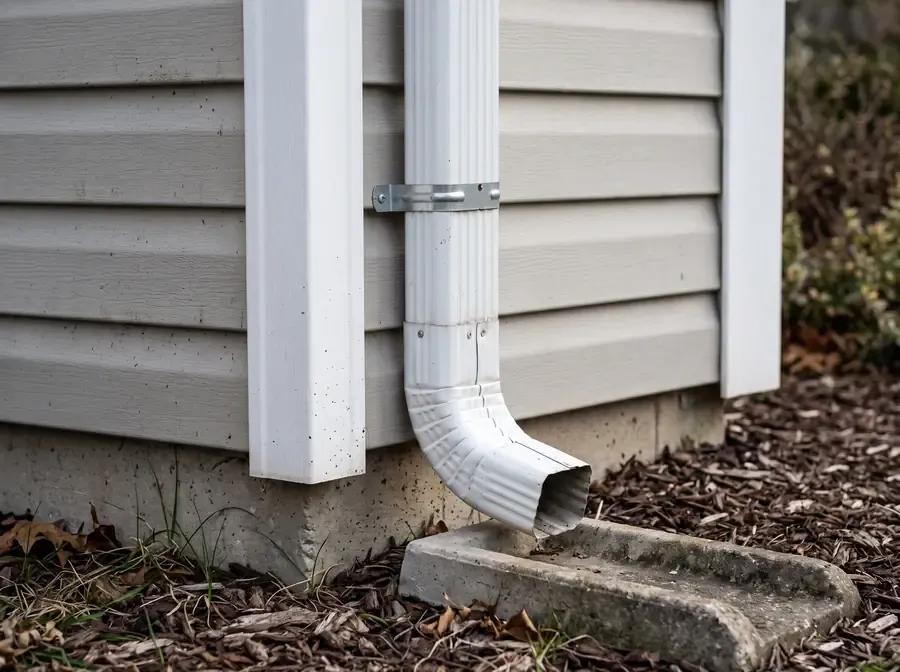
| Downspout extension | A length of pipe or a hinged piece that carries water several feet out from the foundation. |
| Splash block | A trough under a downspout outlet that spreads the flow so it does not dig a hole. |
| Buried drain line | Solid pipe run underground from a downspout to a lower spot, a swale or a pop-up emitter. |
| Pop-up emitter | A spring-loaded cap at the end of a buried line that opens when water pushes up and closes when it drains. |
| Rain barrel | A covered container under a downspout that stores roof water for the garden, with an overflow aimed away from the house. |
| Rain garden | A shallow planted dip that takes downspout water and lets it soak in. Roswell's watershed staff have promoted them to protect local streams. |
| Red clay | Georgia's dense clay subsoil. It sheds water slowly once wet, so roof water dropped at the foundation tends to pool or run across the surface. |
Drainage at a glance
| What people ask | Short answer |
|---|---|
| How far out? | Several feet at least |
| Uphill side of a slope? | Buried line around the house |
| Street drain? | Ask and check rules first |
| Rain garden? | On gentle slopes away from the house |
Where drainage matters around Roswell
| Neighborhood or town | Why it comes up there |
|---|---|
| Riverside Roswell | Steep lots toward the creeks |
| Mountain Park | Lakeside lots where silt matters |
| Norcross | Narrow lots close to neighbors |
A first step worth taking
After the next big rain, walk the house and mark each place water stands or washes out. Those spots show where downspouts need to send water further.
Basements and crawl spaces
Water against the foundation on clay can find its way into basements and crawl spaces. Moving downspout discharge away from the walls is one of the simplest ways to keep them drier.
How to check a gutter contractor in Georgia
Georgia licenses residential and general contractors through the State Licensing Board for Residential and General Contractors, part of the Secretary of State's office. Licensing guides summarizing the law put the threshold at residential work valued over $2,500, so a full gutter replacement usually falls under it while a small repair may not. Ask for the license number and check it with the Secretary of State before you sign. A city business license is not the same thing. Get the quote in writing, naming gutter size, metal and thickness, color, hanger type and spacing, the number and size of downspouts, where each will drain and who removes the old gutters. Inside Roswell's historic district, a material change to a building's appearance needs a Certificate of Appropriateness from the city's Historic Preservation Commission, so check before visible details change.