
On this page
What does a good installation include?
A gutter is a small part of the house that does a big job. On a Roswell roof it has to catch about 52 inches of rain a year, the figure in the climate table on Wikipedia, most of it in storms rather than gentle showers. It also has to carry the weight of wet oak leaves and pine straw between cleanings. A careful installation covers:
- Measuring every run and the roof area draining to it, so each side gets the right size and enough outlets.
- Checking the fascia and drip edge before anything goes up. Soft boards are replaced first.
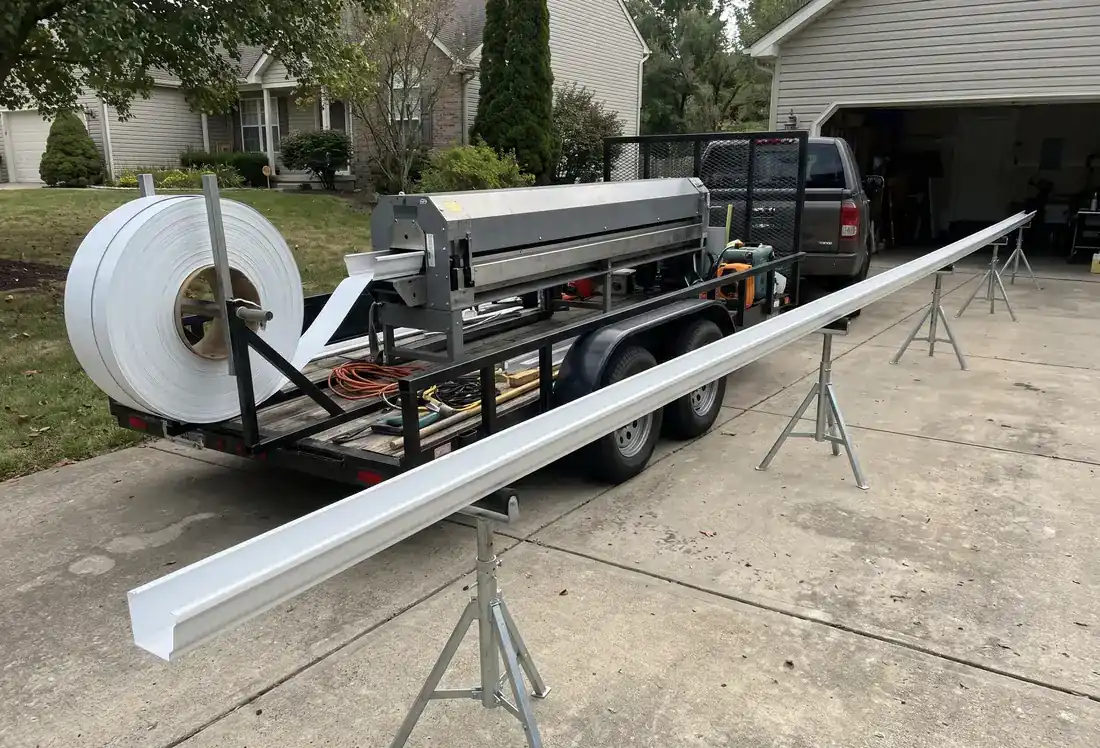
- Forming seamless runs from coil on site, cut to the exact length of each wall.
- Setting the slope at roughly a quarter inch per 10 feet toward each outlet, so water does not sit.
- Hanging the gutter on hidden hangers about every 2 feet, screwed into sound wood.
- Sealing corners and end caps and riveting outlets.
- Placing downspouts where water can be carried away from the foundation, not dumped beside it.
- Water-testing every run before the crew leaves.
Which gutter types are common around Roswell?
| Type | Where it fits | Read more |
|---|---|---|
| 5-inch seamless K-style | Ranches and smaller two-story homes | Seamless gutters |
| 6-inch seamless K-style | Large, steep or valley-heavy roofs | 6-inch gutters |
| Half-round | Older homes and the historic district | Half-round gutters |
| Copper | Landmark, stone and custom homes | Copper gutters |
| Aluminum in .032 | Wooded lots where limbs and ladders dent thinner coil | Aluminum gutters |
| 3x4 downspouts | Any roof that overflows at the outlet | Downspouts |
How does Roswell's weather shape the job?
Rain is the main load. March is the wettest month at about 6 inches and October the driest at about 3.6, according to the same Wikipedia table, but averages hide the storms. In September 2009 the floods that the National Weather Service called epic swept metro Atlanta, and the highest 24-hour total, 21.03 inches, was recorded in Douglas County, according to the NWS anniversary summary. A gutter does not have to survive a once-in-500-years flood, but it should be sized for the heavy hour, not the average month.
Trees are the second load. Much of Roswell is wooded, and the city's own tree guide notes that its first tree-protection law dates to 1878. Big hardwoods drop leaves, catkins and limbs, and pines shed straw all year. Thicker coil, close hanger spacing and guards all help.
Winter ice is the occasional third. North Georgia gets the odd ice storm, and a gutter loaded with ice and frozen leaves can pull on weak fixings.
How does the lot affect drainage?
Roswell is hilly, and much of it sits on Georgia red clay, which takes water slowly once it is wet. Water dropped at the foundation on the uphill side of a house tends to stay there; on the downhill side it can wash out beds and walks. Good installations plan each downspout's path: extensions, splash blocks, buried lines to daylight on a slope, or a rain garden. Roswell's watershed staff have encouraged rain gardens to protect local streams, the AJC reported.
What should a quote include?
- Gutter size and profile for each side.
- Metal and thickness, such as .027 or .032 aluminum.
- Color for gutters and downspouts.
- Hanger type and spacing.
- Number, size and position of downspouts, and where each drains.
- Fascia repair, priced per foot or per board.
- Removal and haul-away of the old system.
- Guards, if wanted, priced separately.
Terms you will hear
| Term | What it means on a Roswell house |
|---|---|
| Seamless gutter | Gutter formed from a coil at the house in one length per wall, leaving joints only at corners, ends and outlets. |
| K-style gutter | The usual flat-backed profile with a curved face. Width for width it carries more water than half-round. |
| Hidden hanger | A bracket that hooks under the front lip and screws through the back of the gutter into the fascia, out of sight from the yard. |
| Drip edge | An L-shaped metal strip along the edge of the roof deck that throws water out into the gutter instead of letting it curl back onto the wood. |
| Fascia | The trim board across the rafter ends that the gutter screws into. Once it softens from leaks, no hanger holds well. |
| Slope | The gentle fall of a gutter toward its outlet, commonly about a quarter inch in 10 feet, so water does not sit in the trough. |
| Outlet | The hole in the gutter bottom where the downspout connects, usually through a riveted drop sleeve. |
| Downspout | The upright pipe that brings water down from the gutter. Common sizes are 2x3 and 3x4 inches. |
What does it cost?
National guides put seamless aluminum at roughly $9 to $13 a foot installed for 5-inch and $12 to $18 for 6-inch, according to Angi. Copper runs much higher, about $25 to $40 a foot according to This Old House. The Roswell cost guide explains what moves a quote.
Installing gutters on a historic house
On older houses near the town center, installation often means half-round gutters on brackets or straps, round downspouts and careful work around old fascia. Inside the historic district, check with the city before changing style or material.
Gutters and the roof edge
New gutters work best with a sound roof edge. If the shingles stop short of the fascia, or there is no drip edge, water can run behind the gutter whatever its size. Ask the contractor to check the roof edge and add drip edge or a gutter apron where needed.
How to check a gutter contractor in Georgia
Georgia licenses residential and general contractors through the State Licensing Board for Residential and General Contractors, part of the Secretary of State's office. Licensing guides summarizing the law put the threshold at residential work valued over $2,500, so a full gutter replacement usually falls under it while a small repair may not. Ask for the license number and check it with the Secretary of State before you sign. A city business license is not the same thing. Get the quote in writing, naming gutter size, metal and thickness, color, hanger type and spacing, the number and size of downspouts, where each will drain and who removes the old gutters. Inside Roswell's historic district, a material change to a building's appearance needs a Certificate of Appropriateness from the city's Historic Preservation Commission, so check before visible details change.