
On this page
- How are seamless gutters made?
- Why do joints matter in Roswell?
- Seamless or sectional?
- Which profiles and sizes are available?
- What thickness should be used?
- How should seamless gutters be hung here?
- What happens on installation day?
- Parts on a seamless system
- What do seamless gutters cost?
- Seamless gutters at a glance
- Where seamless gutters matters around Roswell
- A first step worth taking
How are seamless gutters made?
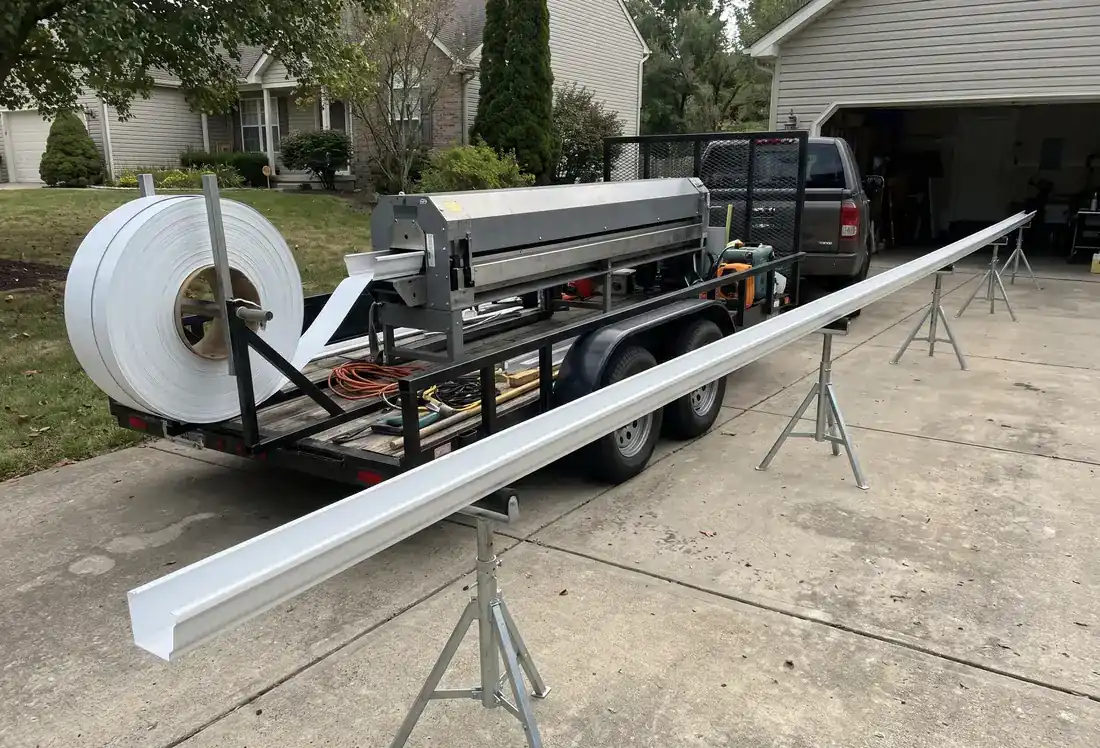
A contractor tows a gutter machine to the house. Painted coil feeds through rollers that bend it into the gutter profile, and the machine cuts each piece to the length measured from the eave. The run is carried to the ladder, set on hangers and fixed. Corners are cut, riveted and sealed; end caps are crimped and sealed; outlets are cut where downspouts will go.
The result has no joints along its length. A typical two-story Roswell house might end up with eight to twelve joints in all, at corners and ends, instead of dozens.
Why do joints matter in Roswell?
Every joint is sealed with a compound that has to stretch and shrink through hot, humid summers and the odd freezing winter night, hold up under the weight of wet leaves and sit in water whenever the gutter drains slowly. The Wikipedia climate table puts Roswell's annual precipitation at about 52.3 inches, with March the wettest month at around 6 inches. Joints get wet often. Fewer joints means fewer places for that sealant to fail.
Joints also catch debris. The lip of a slip connector inside a sectional gutter is a ledge where pine straw and oak catkins collect and start a dam. On a wooded Roswell lot that matters as much as the leak itself.
Seamless or sectional?
| Feature | Seamless | Sectional |
|---|---|---|
| Joints along a run | None | Every 10 or 20 feet |
| Where leaks start | Corners and end caps | Corners, end caps and every connector |
| Installed by | A contractor with a machine | Contractor or homeowner |
| Typical metals | Aluminum, steel, copper | Vinyl, aluminum, steel |
| Debris catch points | Few | Every connector |
| Upfront cost | Higher per foot | Lower per foot |
See the seamless vs sectional guide.
Which profiles and sizes are available?
- 5-inch K-style: common on ranches and smaller two-story homes.
- 6-inch K-style: more capacity and a stiffer section for large roofs; see 6-inch gutters.
- Half-round: for older homes, often in the historic district; see half-round gutters.
- Larger commercial profiles: for long roofs on shops and offices.
What thickness should be used?
Aluminum seamless gutter comes mostly in .027 and .032 inch. The heavier coil costs more but dents less when limbs fall or ladders lean on it, and it holds its line better under wet leaves. Under Roswell's big hardwoods, .032 is often worth asking about. See aluminum gutters.
How should seamless gutters be hung here?
- Hidden hangers screwed into the fascia about every 2 feet, closer under heavy trees.
- Slope of about a quarter inch per 10 feet so water does not stand.
- Drip edge in place so water lands in the trough, not behind it.
- Expansion joints on very long runs.
What happens on installation day?
- The old gutters, spikes and downspouts come off and are hauled away.
- The fascia is checked; soft boards are marked for repair.
- Each wall is measured and the machine forms a run to that length.
- Hangers go on and each run is lifted into place.
- Corners are mitered, riveted and sealed; end caps go on.
- Outlets are cut, downspouts fitted and strapped, and discharge set up.
- Water is run through each gutter to check slope and joints.
Parts on a seamless system
| Term | What it means on a Roswell house |
|---|---|
| Seamless gutter | Gutter formed from a coil at the house in one length per wall, leaving joints only at corners, ends and outlets. |
| Coil stock | The roll of painted aluminum, steel or copper fed through the seamless gutter machine. |
| K-style gutter | The usual flat-backed profile with a curved face. Width for width it carries more water than half-round. |
| Hidden hanger | A bracket that hooks under the front lip and screws through the back of the gutter into the fascia, out of sight from the yard. |
| Miter | The corner joint, cut, riveted and sealed, and the most common source of a gutter leak. |
| End cap | The piece that closes the end of a gutter run, crimped and sealed in place. |
| Outlet | The hole in the gutter bottom where the downspout connects, usually through a riveted drop sleeve. |
| Slope | The gentle fall of a gutter toward its outlet, commonly about a quarter inch in 10 feet, so water does not sit in the trough. |
What do seamless gutters cost?
National guides put seamless aluminum at roughly $9 to $13 a foot installed for 5-inch and $12 to $18 for 6-inch, according to Angi. Height, corners, downspouts, fascia work and guards change the total. The Roswell cost guide explains each factor.
Seamless gutters at a glance
| What people ask | Short answer |
|---|---|
| One piece per wall? | Yes; joints only at corners, ends and outlets |
| Most common metal here? | .032 aluminum |
| Still need sealant? | At miters and end caps |
| Pair with guards? | Under pines and oaks, often micro-mesh |
Where seamless gutters matters around Roswell
| Neighborhood or town | Why it comes up there |
|---|---|
| Dunwoody | Replacing aging sectional gutters on 1970s homes |
| East Cobb | Older ranches with leaking connectors |
| Crabapple | Upgrading builder gutters on newer homes |
A first step worth taking
Count the joints on your current gutters. If there is a connector every 10 or 20 feet and several drip in each storm, a seamless quote is worth getting before the wet spring.
How to check a gutter contractor in Georgia
Georgia licenses residential and general contractors through the State Licensing Board for Residential and General Contractors, part of the Secretary of State's office. Licensing guides summarizing the law put the threshold at residential work valued over $2,500, so a full gutter replacement usually falls under it while a small repair may not. Ask for the license number and check it with the Secretary of State before you sign. A city business license is not the same thing. Get the quote in writing, naming gutter size, metal and thickness, color, hanger type and spacing, the number and size of downspouts, where each will drain and who removes the old gutters. Inside Roswell's historic district, a material change to a building's appearance needs a Certificate of Appropriateness from the city's Historic Preservation Commission, so check before visible details change.